Retro Engineering
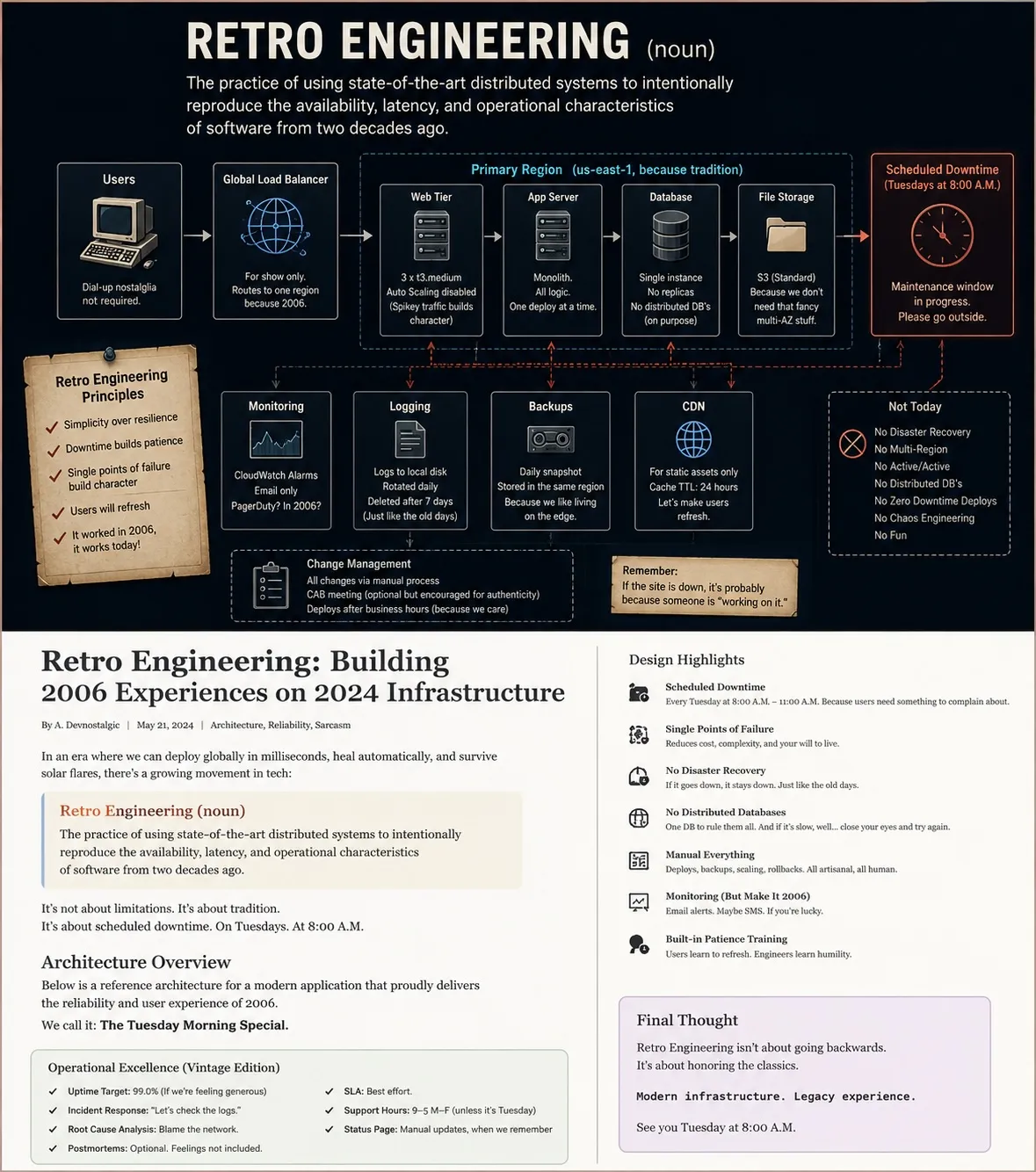
Retro Engineering (noun) — the practice of using state-of-the-art distributed systems to intentionally reproduce the availability, latency, and operational characteristics of software from two decades ago.
The rest of this site is about wringing every microsecond out of an H100, keeping thousands of GPUs busy, and making distributed systems fail in ways that users never notice.
This post is not that. Consider it a palate cleanser.
We’ve spent the last fifteen years learning how to deploy globally in milliseconds, survive datacenter failures, recover automatically, and eliminate scheduled downtime. We built autoscaling, service meshes, multi-region replication, distributed databases, self-healing orchestration, and more observability than NASA had for the Apollo missions.
And yet, something is missing.
A certain character. A texture that only comes from software that might, at any moment, simply stop working until someone gets back from lunch.
I call this Retro Engineering. The reference architecture above is affectionately known as The Tuesday Morning Special.
Design goals
Modern systems optimize for availability, resilience, performance, and user experience. Retro Engineering asks a different question.
What if we optimized for nostalgia?
Our target user experience includes:
- Scheduled downtime.
- Loading screens that encourage reflection.
- Deployments announced by email.
- A support engineer saying “Works on my machine.”
- Databases that become philosophical under load.
The principles
-
Simplicity over resilience. Every replica you don’t run is a replica that can’t disagree with you.
-
Downtime builds patience. For the users and the on-call engineer.
-
Single points of failure build character. A system with no SPOF has nothing left to teach us.
-
Users will refresh. This is not a bug. It is a feature with the keyboard shortcut
F5. -
Hope is a valid retry strategy.
-
It worked in 2006. Citation: it worked in 2006.
Capacity planning
Capacity planning has become unnecessarily complicated. Our process is refreshingly simple.
- Estimate peak traffic.
- Divide it by two.
- Buy that many servers.
If demand exceeds capacity, users are automatically enrolled in our Virtual Waiting Room™, where they can reflect on their life choices.
Architecture decisions
Some people have asked why the reference architecture intentionally avoids many modern best practices. The answer is simple.
Those practices make things too reliable.
Database
One database. One leader. No replicas.
If the database goes down, nothing can become inconsistent.
Consistency through complete unavailability.
Load balancing
Traffic enters through a Global Load Balancer. It routes every request to us-east-1.
Not because it’s closest. Because that’s where the server is.
Auto Scaling
Modern systems automatically add capacity. Retro Engineering automatically adds confidence.
When CPU reaches 100%, we simply assume traffic will calm down eventually. Historically, this has happened every single time.
Kubernetes
People often ask why we’re running Kubernetes. Simple: it makes architecture diagrams look expensive.
Eventually every request reaches a VM named:
prod-db-final-v7-final-final
Caching
Static assets receive a 24-hour TTL. If you shipped a CSS fix five minutes ago, the cache respectfully disagrees.
Eventually the cache expires. Nature heals.
Logging
Logs are written to local disk, rotated daily, and deleted after seven days.
If you needed those logs on day eight, you should have been more proactive.
Disaster recovery
Our disaster recovery documentation is stored in the production database. This guarantees the documentation is always synchronized with production.
Monitoring
Our monitoring philosophy is intentionally minimalist. If users haven’t emailed us, everything is probably fine.
PagerDuty is replaced by Greg from Operations, who occasionally checks Slack.
Change management
Every deployment requires approval from:
- Engineering
- Operations
- Security
- Dave
- Whoever still remembers how production works
Emergency deployments are strongly discouraged. Emergencies should have been scheduled in advance.
What we are proudly not doing
No disaster recovery. No multi-region. No active/active. No distributed databases. No zero-downtime deployments. No chaos engineering. No feature flags. No canary releases. No blue/green deployments. No fun.
One database to rule them all. If it’s slow, close your eyes and try again.
Scheduled downtime
Every Tuesday from 8:00–11:00 A.M., the site is unavailable for maintenance.
Not because it needs to be. Because users need something to complain about, and because a maintenance window is the closest thing software has to a national holiday.
If maintenance finishes early, we wait until 11:00 anyway. Tradition matters.
If the site is down outside that window, someone is almost certainly “working on it.”
FAQ
Why not deploy continuously?
Continuous deployment removes the anticipation.
Why don’t you use multi-region?
If one region was good enough for us in 2006, it’s good enough today.
Does this architecture scale?
Horizontally? No.
Emotionally? Absolutely.
Is this cloud native?
Technically everything runs in the cloud. The cloud just happens to contain one server.
Roadmap
We’re excited about several upcoming improvements.
- SSL certificate expiration as a service
- Manual failover requiring two engineers and a conference call
- A Redis cache that occasionally remembers things
- Scheduled DNS propagation
- Maintenance windows for the maintenance page
Final thought
Retro Engineering isn’t about going backwards. It’s about honoring the classics.
Modern infrastructure. Legacy experience.
See you Tuesday at 8:00 A.M.